Pictogram - Picture Cryptogram
Joy VendorWord
4.765.00 Reviews
- Version
- 1.5.14
- Installs
- 100.00K
- Age Rating
- Everyone
Screenshots
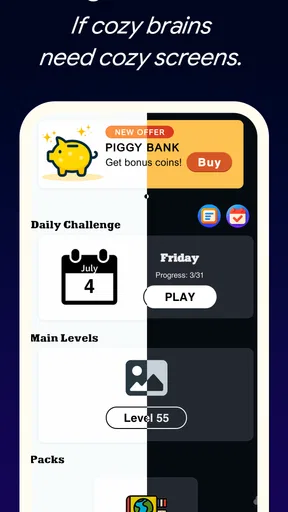
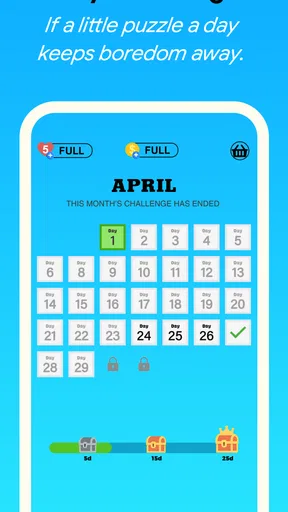
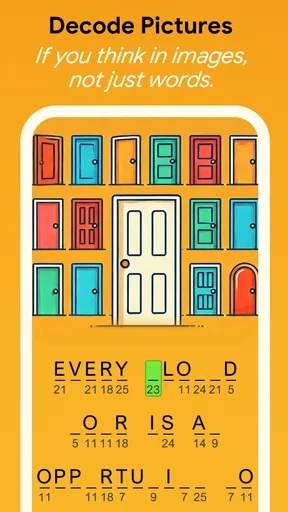
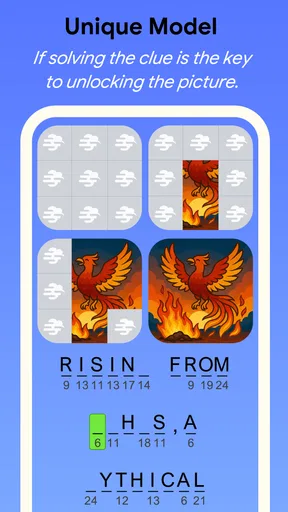
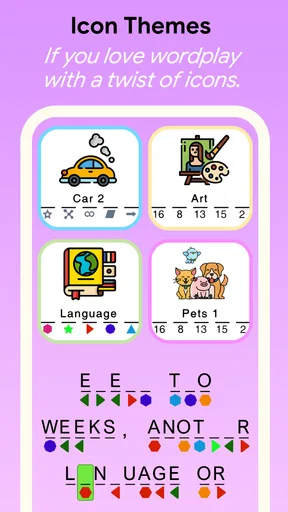
Our Review of Pictogram - Picture Cryptogram
 Analysis by Appyee
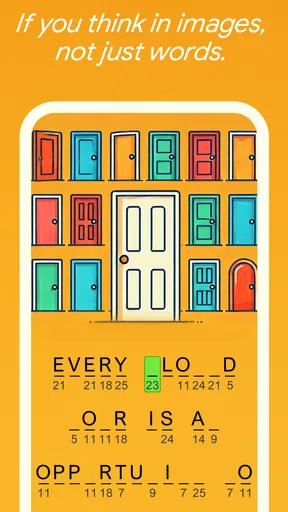
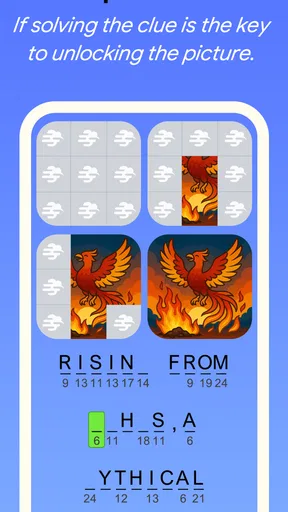
I installed Pictogram - Picture Cryptogram expecting a light word game, and that is exactly where it fits best: a casual puzzle experience built around pictures, familiar expressions, and the small satisfaction of finding the phrase hidden in front of you. The basic action is simple. I look at a set of visual clues, try to connect them with an idiom or word idea, enter my answer, and immediately find out whether my interpretation works. That short loop makes it easy to play for a few minutes without needing to learn a complicated system first.
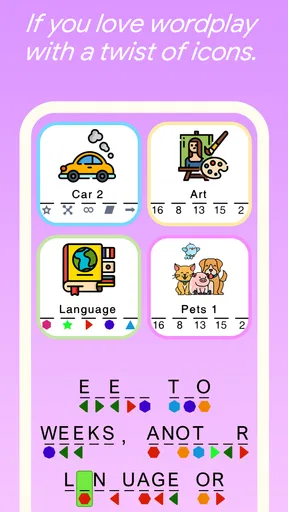
What makes it more interesting than a plain anagram game is the way it asks me to move between images and language. A picture may point to an object, an action, a sound, or an expression rather than a direct dictionary answer. I have to stop treating the screen as a simple matching exercise and start asking what the images suggest together. That change in viewpoint is where most of the enjoyment comes from.
How the puzzle loop feels in actual play
I’ll look more closely at how the picture-to-phrase loop shapes a typical session, especially the point where a quick guess turns into a change of perspective. That distinction helps explain why some riddles feel satisfyingly clear while others invite a pause before trying again.
The first action is looking past the obvious answer
My first move in each puzzle is not typing. It is observing. I check every image, notice repeated ideas, and try to decide whether the answer should be a literal word or a familiar phrase. This matters because the game is not at its best when I rush toward the first object I recognize. The visual clues are more useful when I treat them as parts of a sentence or expression.
For example, I might see an image that suggests an everyday item and another that suggests movement or emotion. The useful question is not simply “What are these pictures?” but “What would these pictures mean when placed together?” That small mental shift creates the cryptogram feeling. It also makes the game suitable for players who enjoy language puzzles but do not want the dense grids or strict letter management found in traditional crossword apps.
The interface is approachable enough for a quick start. I do not need a long tutorial to understand the purpose of the screen, and the age rating of Everyone makes the concept accessible to a broad household audience. Younger players can focus on naming images, while adults may enjoy the extra step of recognizing an idiom or interpreting a visual pun. The difficulty naturally depends on vocabulary and cultural familiarity, so the same puzzle can feel obvious to one person and surprisingly slippery to another.
That variation is one of the game’s strengths, but it also creates an important limitation. If I do not know a particular expression, the puzzle can feel less like deduction and more like guessing what the creator had in mind. I can usually work through the clues, but success sometimes depends on recognizing the intended phrase rather than proving it from the images alone.
Feedback keeps the next attempt moving
Once I submit an answer, the immediate result gives the session its rhythm. A correct solution closes one small mental loop: I made a connection, tested it, and saw it pay off. A wrong answer does not end the experience; it sends me back to the same clues with a different interpretation. That quick feedback is important because the puzzles are designed for repeated attempts rather than long stretches of silent uncertainty.
I found the most enjoyable moments came after an incorrect first idea. I would initially read the pictures literally, then notice that one clue was probably pointing toward a phrase instead of an object. The answer often became clear only after I deliberately changed the way I was grouping the images. In that sense, the game rewards flexibility more than raw speed.
The feedback also makes the game easy to share informally. If I am playing beside someone, we can offer competing interpretations without needing to explain complicated rules. One person may identify the phrase while the other notices the visual connection. That makes it a pleasant choice for a short break with family or friends, although players looking for a deep competitive word system may find the interaction too lightweight.
A useful personal technique is to separate clue collection from answer formation. I first name each image in the simplest way possible, then list related words mentally, and only after that search for an expression. This prevents me from locking onto an attractive but incorrect guess. It is especially helpful when a picture could represent several things, such as an action, a feeling, or a common saying.
The reward is recognition rather than complexity
The reward in this game is mainly the moment of recognition. I see how the images fit, enter the phrase, and experience that brief “of course” reaction. That is different from the reward structure of a long word-building game, where I may be chasing a high score, a large chain, or a carefully optimized board. Here, the pleasure is more immediate and self-contained.
The large collection of picture riddles gives that feeling room to continue. The game is presented as containing over a thousand visual word challenges, which is enough to make it feel like a recurring pastime rather than a single puzzle pack. I would not approach it as a serious vocabulary course, but it does encourage me to think about idioms, synonyms, word associations, and the difference between literal and figurative language.
That makes it particularly useful in everyday situations where I want something mentally active without committing to a long session. I can open it while waiting for an appointment, play a handful of puzzles during a commute break, or use it as a low-pressure alternative to scrolling through social feeds. The short-answer format means I can stop after a successful solve without leaving a complicated board unfinished.
It also works well as a family-friendly conversation starter. If a child recognizes the pictures but not the phrase, I can explain the expression and discuss why the clues point toward it. In that setting, the game becomes more than a private challenge. It gives players a reason to talk about language, although the value depends on the group being comfortable with occasional trial and error.
How the session resets without feeling like a chore
After solving a puzzle, the natural question is whether I want to try another. The game’s strongest retention point is not a complicated progression system; it is curiosity about the next visual combination. Each completed riddle resets the mental slate, and the next one asks me to build a new interpretation from scratch. That clean reset helps prevent one difficult puzzle from dominating the whole session.
I like this structure because it supports two different habits. I can play casually, solving one or two puzzles whenever I have a spare moment, or I can continue through a longer run when the answers are arriving quickly. The decision to start another round comes from the feeling that the next clue set might be easier, funnier, or more satisfying than the last one.
There is a trade-off here. Players who prefer a strong sense of long-term advancement may find the reset too modest. A conventional word game with levels, timed rounds, leaderboards, or extensive statistics may provide a clearer feeling of measurable progress. Pictogram is better suited to people who value a sequence of small discoveries over a highly structured campaign.
Another practical point is that the game is free to download, while in-app purchases range from $0.99 to $99.99 per item. That makes it easy to try without an upfront payment, but I would still approach optional purchases carefully. A casual puzzle game can be enjoyable without turning every difficult answer into a reason to spend money. Before buying anything, I would decide whether I am comfortable using hints or simply leaving a stubborn riddle for later.
What the developer’s approach gets right
Joy Vendor has chosen a format that is easy to understand but not entirely automatic. The images provide an accessible entry point, while the idiom-focused answers add a layer that prevents the game from becoming a basic picture quiz. That balance is why I can recommend it to someone who normally avoids complicated word games.
The current version is 1.5.14, and the game supports devices running Android 7.1 or later. Those details make it relevant to people using older compatible phones who do not want to replace a device just to try a casual puzzle. The title has also reached over 100K installs and holds a 4.7 average from around 2K ratings, which suggests that its simple concept has connected with a substantial group of players.
The rating should not be read as a promise that every puzzle will suit every player. Picture riddles are naturally subjective. Some answers feel neatly constructed, while others may require a cultural reference or wording choice that is not immediately obvious. I personally found that the game is more enjoyable when I accept that occasional ambiguity as part of the format rather than expecting every clue to work like a formally defined crossword entry.
Where it fits beside other word games
Compared with a crossword app, this game asks for less sustained board management. I do not need to maintain a grid, track crossing letters, or plan several moves ahead. That makes it friendlier for short sessions, but it also means it offers less depth for players who enjoy building a solution through intersecting evidence.
Compared with an anagram game, the main challenge is interpretation rather than rearranging a fixed set of letters. I am not simply searching through possible spellings. I am translating images into concepts and then connecting those concepts to language. Players who enjoy lateral thinking will probably prefer this approach, while those who like precise letter mechanics may find it less satisfying.
Compared with a trivia game, the focus is narrower and more visual. I am not being tested on history, science, or current events. That is a benefit when I want a game that feels less like an exam, but it also means the challenge depends heavily on language familiarity. Someone learning English or playing across cultures may encounter expressions that are harder to infer than the images themselves.
For that reason, I would choose this over a standard word search when I want a quick “aha” moment, but I would choose a crossword or anagram title when I want a more systematic challenge. It is not a replacement for every kind of word game. Its appeal comes from the specific space between visual guessing and phrase recognition.
Small strategies that make difficult riddles fairer
My most useful strategy is to read the images in more than one direction. If the left-to-right interpretation feels forced, I try combining the clues by theme, sound, or action. I also ask whether one picture is functioning as a connector rather than contributing a literal word. That approach often reveals why a seemingly unrelated image is present.
A second strategy is to avoid overvaluing the most detailed picture. A highly recognizable image can pull me toward an exact noun, but the intended answer may depend on a broader association. I get better results when I consider simple alternatives: a picture of a person may suggest a role, behavior, mood, or verb rather than the person’s visible activity.
A third strategy is knowing when to pause. Because the game resets cleanly after each riddle, there is little benefit in forcing a solution while frustrated. I can leave the puzzle, play another, and return later with a less fixed interpretation. This is more effective than repeatedly entering near-identical guesses, especially when the obstacle is an unfamiliar idiom rather than a lack of vocabulary.
These habits also reveal the game’s educational edge. It does not teach definitions in a formal lesson format, but it encourages me to notice how ordinary words combine into expressions. If I play with another person, explaining why an answer works can be more valuable than simply seeing the correct phrase and moving on.
Who should play, and who should skip it
I would recommend it to casual players who enjoy language, visual clues, and short rounds with immediate feedback. It is a good match for someone who wants a family-friendly pastime, a gentle brain-training option, or a word game that does not demand a large uninterrupted block of time. It is also a sensible choice for players who like discovering idioms rather than only manipulating letters.
I would be more cautious about recommending it to players who need exact, highly consistent puzzle logic. If you dislike answers that depend on idiomatic wording, regional familiarity, or a creator’s visual interpretation, some riddles may feel arbitrary. Likewise, people seeking competitive scoring, deep strategy, or a substantial narrative campaign should look toward another category of game.
The free entry point makes trying it straightforward, and the Everyone rating broadens its audience. Still, I would keep the purchase range in mind and treat optional spending as a personal choice rather than part of the core reason to play. The main value is in the repeated solve-and-reset cycle, not in buying access to a more serious form of word mastery.
My verdict on the repeatable loop
After playing, I see the core loop as a clear sequence: inspect the pictures, form a phrase, submit the answer, enjoy the recognition or rethink the clue, then decide whether the next riddle deserves another minute. The feedback is quick, the reward is understandable, and the reset is clean enough to make one more puzzle feel low-risk.
The best reason to keep playing is the change in perspective from image to expression. When the clues click, the game delivers a compact but genuine word-puzzle payoff. When they do not, the experience can become guesswork, and that is the main friction I would want prospective players to understand before installing it.
Overall, I think Pictogram - Picture Cryptogram is a pleasant free word game for relaxed, repeatable sessions. Joy Vendor keeps the entry barrier low while adding enough idiom-based interpretation to distinguish it from a basic picture quiz. It will not replace a crossword for depth or an anagram game for letter precision, but if you want to decode visual ideas, train flexible thinking, and start another short session whenever curiosity returns, it is an easy title for me to recommend.
Verdict
Strengths of Pictogram - Picture Cryptogram
- Simple rules make it easy for new players to start quickly.
- Short puzzles are convenient for quick sessions on the go.
- Visual clues offer a refreshing alternative to word-only puzzles.
- Progressive challenges can help maintain interest over time.
- Suitable for players who enjoy casual, low-pressure brain games.
Limitations of Pictogram - Picture Cryptogram
- Some picture clues may feel vague or open to multiple answers.
- Later puzzles can become repetitive if played for long sessions.
- Hints or extra-help options may reduce the challenge for experienced users.
- Requires a steady internet connection for certain app features.
- Small visual details may be harder to recognize on compact screens.
Other Releases by Joy Vendor
View All

Similar Picks in This Category
View All
Word Search - Word Puzzle Game
Bluetile4.8

Word Search Quest - Puzzles
Blackout Lab4.8

CodyCross: Crossword Puzzles
Fanatee, Inc.4.7

Words of Wonders: Crossword
Fugo Games4.9

Wordscapes: Word puzzle game
PeopleFun4.7

Word Search Explorer
PlaySimple Games4.9
Frequently Asked Questions
What is Pictogram - Picture Cryptogram, and how is it played?
Pictogram - Picture Cryptogram is a word puzzle game that challenges you to identify familiar phrases, words, or expressions represented through pictures, symbols, and visual clues. You study the arrangement and meaning of the images, then enter your answer using the available letters. The concept is easy to understand, but later puzzles can require creative thinking and careful attention to detail.
Is Pictogram - Picture Cryptogram suitable for beginners and casual players?
Yes. The game is designed to be approachable for casual players because each puzzle uses visual clues rather than complicated rules or specialist knowledge. Early levels generally help you understand how pictograms work before introducing more challenging combinations. However, some answers depend on wordplay, cultural expressions, or interpreting the position of images, so patience may be necessary on harder stages.
Does Pictogram - Picture Cryptogram require an internet connection?
Many puzzle sessions can usually be enjoyed without a constant internet connection, which makes the game convenient for short trips or offline play. However, certain features may depend on connectivity, including advertisements, optional hints, updates, cloud-related functions, or other online services. For the most reliable experience, it is best to open the app online occasionally and keep it updated.
Are hints available if I cannot solve a pictogram?
The game typically provides assistance for puzzles that are difficult to solve, such as revealing letters, removing incorrect options, or exposing part of the answer. These hints may use an in-game currency or be limited by the game’s progression system. Before spending any rewards, it is worth examining the image arrangement carefully, since many answers become clearer when read as a phrase rather than a literal object.
Is Pictogram - Picture Cryptogram free to download, and does it contain ads or purchases?
Pictogram - Picture Cryptogram can generally be downloaded and played without paying an upfront purchase price, but free gameplay may be supported by advertisements and optional in-app purchases. Depending on the version and device, ads may appear between levels or when requesting extra help. Review the store listing and purchase settings before downloading, especially if the app will be used by children.
Play our best games!


